Aerosol paints and enamels are a convenient tool for applying coatings to various surfaces. These spray paints are used in everyday life, automotive industry, decorative works and art. Consider, what they are, their advantages, varieties and methods of use. 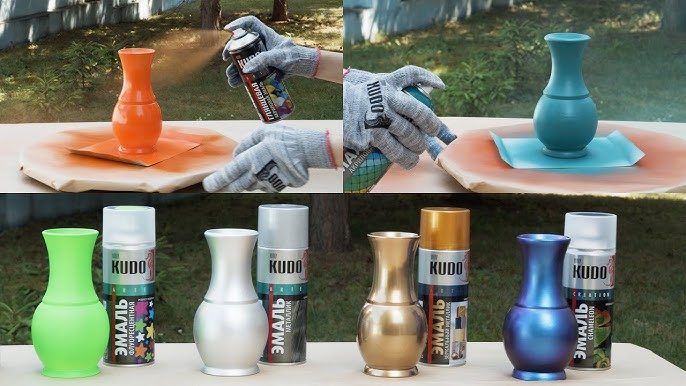
What are paints and enamels in cans??
Paints and enamels in cans - type of paint and varnish materials, which are packed in pressurized metal cylinders and equipped with a spray valve. These products allow you to apply paint to various surfaces in a convenient way., providing fast and even coverage without the use of additional tools, such as brushes or rollers. The paint is applied in an even thin layer, which simplifies the painting process.
Main Components
- Coloring matter: Pigments and dyes for color and opacity of the coating.
- Solvent: Liquid for dissolving pigments and binders.
- Binder: Polymers, ensuring paint adhesion to the surface.
- Propellant gas: Creates pressure in the cylinder and ensures paint atomization.
Advantages of paints and enamels in cans
The use of paints and enamels in spray cans has many advantages:
- Ease of use:
- Ease of application: Spraying allows you to quickly cover large surfaces.
- No need for additional tools: No need for brushes, rollers or other tools.
- Uniform coverage:
- Homogeneous layer: Aerosol spraying provides an even coat of paint without drips.
- Access to hard-to-reach places: Easily covers corners, irregularities and small details.
- Variety of colors and effects:
- Wide range: On website you will find different colors, shades and effects, including metallic, matt, glossy and pearlescent coatings.
- Special effects: Possibility of creating fluorescent, reflective and thermochromic coatings.
Types of paints and enamels in cans
There are several types of spray paints, differing in composition and scope of application:
1. Acrylic paints:
- Benefits:
- Fast drying.
- Good adhesion to various surfaces.
- Fade resistant.
- disadvantages:
- Less resistance to mechanical damage compared to alkyd enamels.
- Application: Decorative works, furniture painting, cars and other objects.
2. Alkyd enamels:
- Benefits:
- High resistance to external factors (moisture, ultraviolet).
- Durable and durable coating.
- disadvantages:
- Long drying.
- Strong odors upon application.
- Application: Metal painting, wood and other materials, requiring protection against corrosion and wear.
3. Epoxy paints:
- Benefits:
- High strength and chemical resistance.
- Durable and wear-resistant coating.
- disadvantages:
- Difficult to apply (mixing components before use).
- Long drying time.
- Application: Industrial facilities, floors, equipment and surfaces, subject to intense influence.
4. Fluorescent and reflective paints:
- Benefits:
- Bright, visible coverings, glow in the dark or reflect light.
- Ideal for special effects and increased safety.
- disadvantages:
- Requires several layers to achieve the desired effect.
- Less durable, require updating.
- Application: Warning signs, decorative elements and special effects.
Methods of using paints and enamels in cans
Proper use of spray paints involves several steps:
- Surface preparation:
- Cleaning: Remove dirt, dust and grease.
- Grinding: If necessary, sand the surface for better adhesion..
- Primer: Apply a primer for better paint adhesion to the surface.
- Applying paint:
- Shaking the can: Shake the can thoroughly before use (1-2 minutes).
- Spraying: Keep the cylinder at a distance 20-30 cm from surface, Apply paint evenly with smooth movements.
- Layers: Apply paint in several thin layers, allowing each to dry before applying the next.
- Shutdown:
- Drying: Allow the paint to dry completely according to the instructions..
- Protection: Apply protective coating if necessary, eg, varnish, to increase strength and durability.
Output
Paints and enamels in spray cans are a convenient tool for various works. They provide even coverage, offer a variety of colors and effects, as well as ease of use. Proper surface preparation, Application technique and adherence to manufacturer's recommendations will help achieve the best results and extend the service life of the coating..